By Chris Acuff
This is certainly not to say all dungeon crawls or encounters are like this, but when I read modules or think of my earlier DM’ing, it seems as though often times enemies are sitting in their designated rooms doing idle animations until the players approach to attack. Sometimes there will be set ups where guys in one room would be able to hear a fight happen elsewhere and will show up after x number of rounds, but many times they will stay in their room and idly listen to their comrades being chopped to bits some 60 feet away. Partly this is due to limits in dungeon and game design, but using intelligent monsters means we can do better.
Players should feel the weight of the conflict long before anyone draws a sword or casts fireball. In our example of the Red Dragon Incorporated game I talked about how after that first skirmish at the merchants house the enemy organization tries to ice the players out of town. Merchants who are in the red dragon system turn them away and even the paladin’s holy order, who accepted a donation from the organization, is not happy with them. This is all part of the “Promise” part of story telling, to use Brandon Sanderson’s Promise, Progress, Payoff framework.
I think of Promise as anything part of the setup of a story, but you can think of it as the promise that the organization is coming for the players.
This is also a great time to build a sense of dread. The enemy boss is only talked about in whispers, no one is even willing to say the name out loud in fear of drawing too much attention, the Red Dragon Bezös has spies everywhere afterall. Actions can lead to dread, like in the last post where I had the dragon attack the players and knights in the night, in the open where it had all the vastness of the sky to use for movement. By setting the camp on fire and getting the knights to leave, this both puts all the focus back on the characters to assault the mountain but also sets up the dragon as a seemingly impossible fight.
The levels that the characters gain between that encounter and the final one will feel weighty and important because they know they need them in order to win.
The progress portion of the storytelling comes about in the actions of the campaign. The players should be able to see and understand that the enemy organization is having to dedicate more resources to dealing with them. The environment should change as the characters get deeper into organization held territory. What are their signs of power? How are they punishing those who resist? How have the lives of regular NPC’s changed under the new power? What have they done to the landscape and how does that mechanically affect the game?
Changing descriptions and setup is still good, but these ideas in progressing the story matter much more if they also change the mechanics of the game in noticeable ways, that’s how the game can reach through the characters to the players.
When we finally do get to a dungeon crawl or fight, the type of boss enemy you’re using should significantly affect how they interact, and they should interact, with the players. I have a shorthand way of thinking about this- are they a strategist, monster, or warlord?
An example of strategist is Stradh in the “Curse of Stradh” – slight spoilers for the final dungeon crawl ahead.
In COS, the players have some huge advantages in the symbol and sunblade, these advantages would make a straight up fight relatively easy against our big bad vampire, so he needs to wear them down beforehand.
Stradh can phase through walls. It is awesome, and should surprise the players in the castle, because even if they have encountered him before they go to the castle, if he has come to talk or try to turn them against each other, he will not have used that ability yet. He should be using this to make sure the player never get a simple long rest in his domain. Using Tiny Hut for a secure long rest? Well it would be a shame if someone phased through the floor and tried to take out the person holding the symbol in the middle of the night. He should do things like this often, being a nuisance and setting up ambushes, especially as the characters break shit in his house.
Stradh is actually a strategist-warlord hybrid. He sends his underlings after the players, sets up ambushes, and uses magic in creative ways to wear down and weaken the players before the final battle, but is also not afraid of getting his hands dirty. If done correctly, he should come off as a terrifying ambush predator who could be lurking behind any corner, but also does not want to stick around under the burn of the daylight coming off that sunsword.
The Dragon in our Red Dragon Incorporated is the monster archetype. The terrain of Prime Mountain has been significantly altered for his desires. All the trees and undergrowth are gone, not just to power the fires of industry, but also so that no creature, all the way down to the last rabbit, can escape his sight as he flies around. Stone paved roads have been built to facilitate the kobold delivery service and the landscape around the road is littered with detritus, making it difficult to sneak through without making noise, should someone try invisibility since there is no top cover. Kobolds are everywhere. It should be a difficult challenge for the players to try to approach without getting caught and the dragon getting called. If they do, great, and if they get caught, they have to fight Bezös out in the open again with a small army of his minions. Maybe they get away, or maybe they lose, roll the dice.
A side note, but losing in DND should be ok. You can lose a campaign. But also, it can be written with the expectation that this might happen, and the bbeg may have a reason to keep the players alive. Like in this instance, after being defeated outside the mountain, he captures them and brings them to… a conference room!
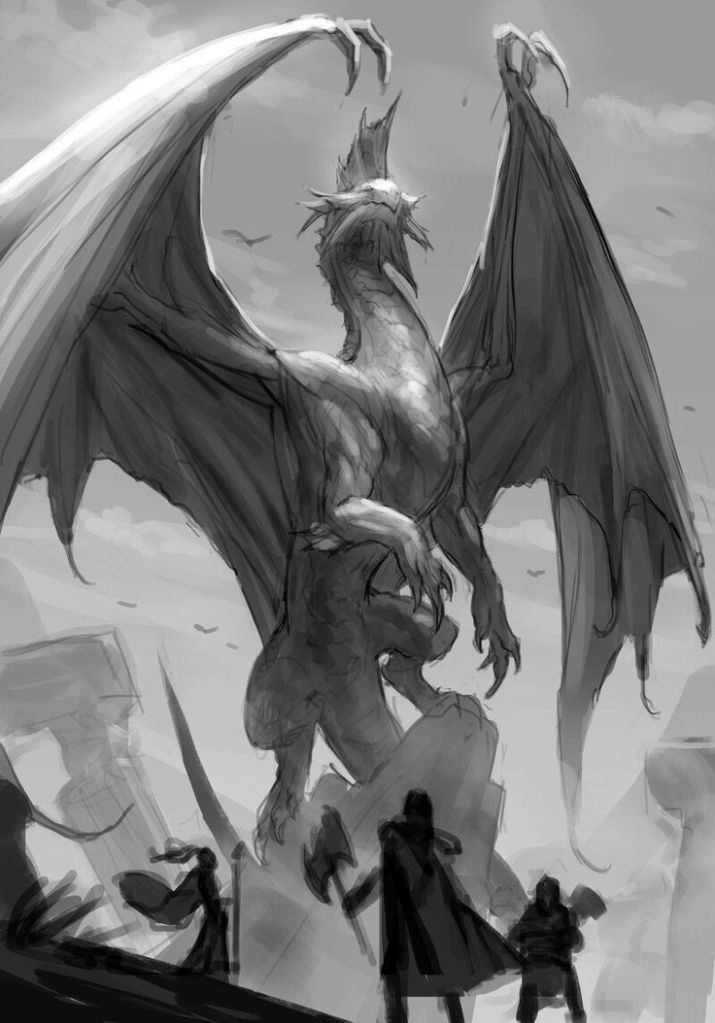
Bezös is a red monopoly dragon, and he just cannot fathom why the characters would choose to resist his scheme. The kobolds are so fast at delivery. He is able to do it cheaper than any other merchant. Yes, he controls prices, and yes, all the gold in the land is getting funneled to the massive pile he sits on and does nothing with, but that’s business baby.
He makes a focus group out of the players to try to understand just what Red Dragon Incorporated needs to do in order to get them in line. Helluva pre-combat interaction. Maybe the party has a chance for a short rest, and maybe the dragon doesn’t have as many minions and is stuck in this more cramped conference room.
Often times, the enemy’s goals are simple, power, personal grievance, or the simplest of all, food. Something I think the monster archetype is simplified to food, but it doesn’t have to be. I think monsters in a setting like DND can have minds that operate alien to a normal person, throwing a twist in our intelligent enemy argument here. What if they are intelligent, but also really weird?
Whatever the attributes of your upcoming boss, think of how they would use those to effect the environment around them and you’ll be well on your way to creating a more memorable villain.
 Paragon
Leave a comment