And Mystery In Games
By James Gildard
Death is a direction. One that we all travel into.
On Tersus, that direction just happens to be reflected materially in a certain region surrounding the south pole of the planet. Of course, being a direction it cannot have an end, and so explorers traveling due south will eventually find themselves walking forever in what is known as
T H E F R O N T I E R
By some hilarious miracle, I’ve been producing too much content lately. I’m eating through ideas and digesting them and shitting them back out again with hardly any time spent chewing let alone actually savoring the flavor. I need something to slow me down. This and hopefully future posts like this are an attempt to do just that. Let’s take all that brain vomit and make it look nice and put it somewhere that maybe my friends can look at it and not contract dyslexia and epilepsy simultaneously from the first paragraph.
Hopefully
So we’ll start somewhere sensible, a little introduction to this game I’ve been running, and a bit of my thinking about how to set it up the way I want.
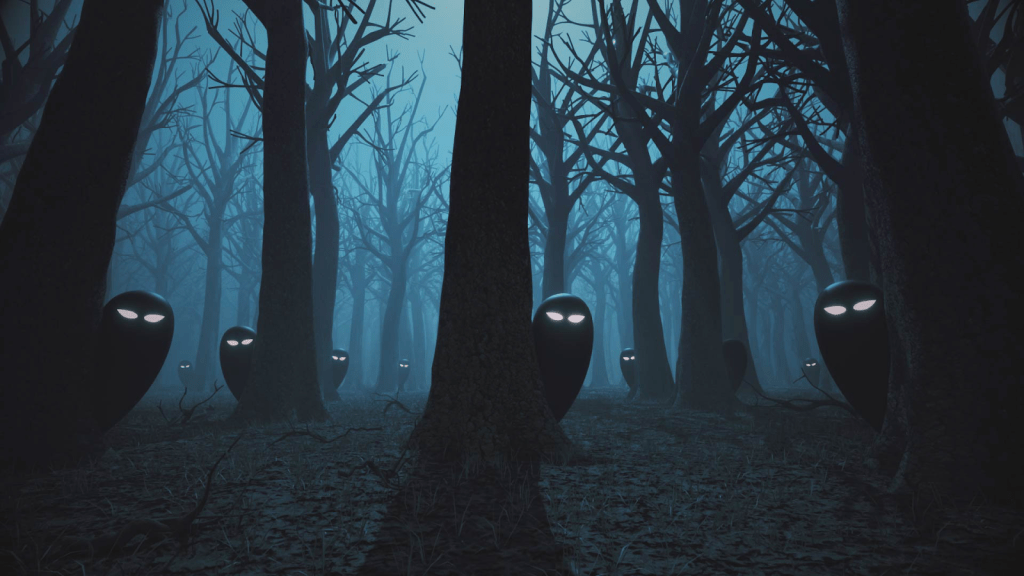
~This is more or less what the Frontier looks like. Foggy forest, dim light and spooky guys everywhere. We’ll talk more about it in later posts~
It is famously unchartable. Very few who go into the Frontier ever come out, and when they do it’s usually because they only spent a day or two there and came right back. The region defies mapping altogether. Really this is because it exists on a non-euclidean manifold which gyrates constantly and switches chirality daily (per planetary rotation), but that’s all beyond the scholars of the day. Wisdom which is lost and buried forever with the Ancients. Perhaps you could uncover it in their sprawling ruins, which lay scattered across the secretly infinite frontier itself. Empires die too, no?
How is it possible that this is all true for just a small part of a spherical planet and not the rest of it? Go fuck yourself, thats how. “But James those words don’t make sense together in the way you described, you just pulled some geometry buzzwords out of your ass and strung em’ together to make it sound complicated.” Of course I did. This is fantasy worldbuilding dipshit, get with the program.
Anyway, the game we’re running in this place is called APPRENTICE and in it, players are hired muscle employed by an organization called the Cartographers Guild. The guild has made history by successfully navigating the frontier and setting up the first ever outpost within it. Hooray, colonization!
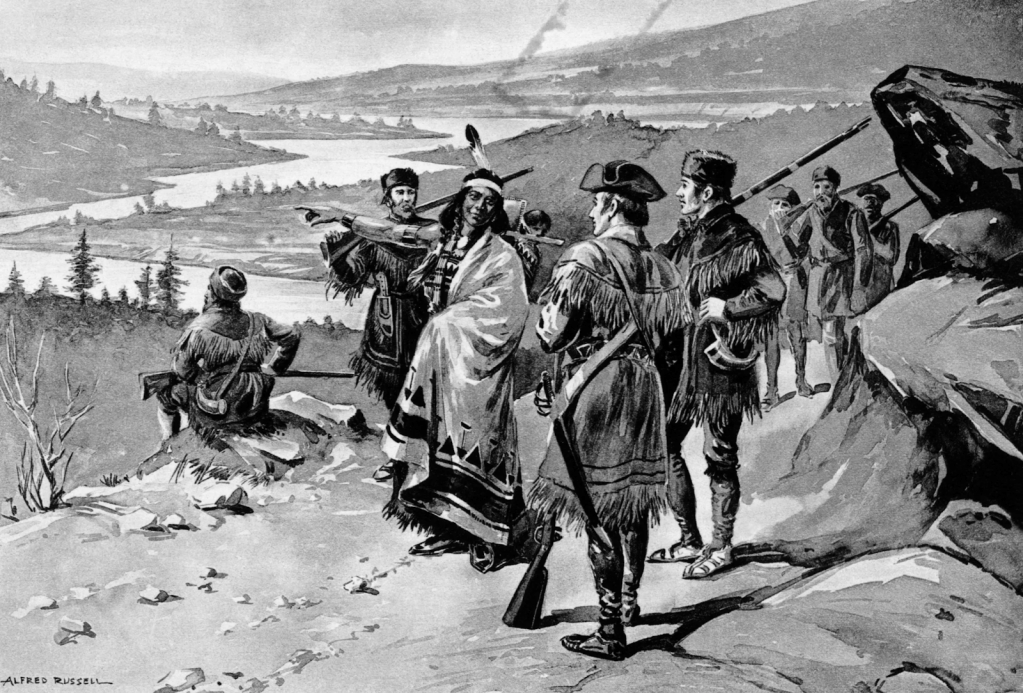
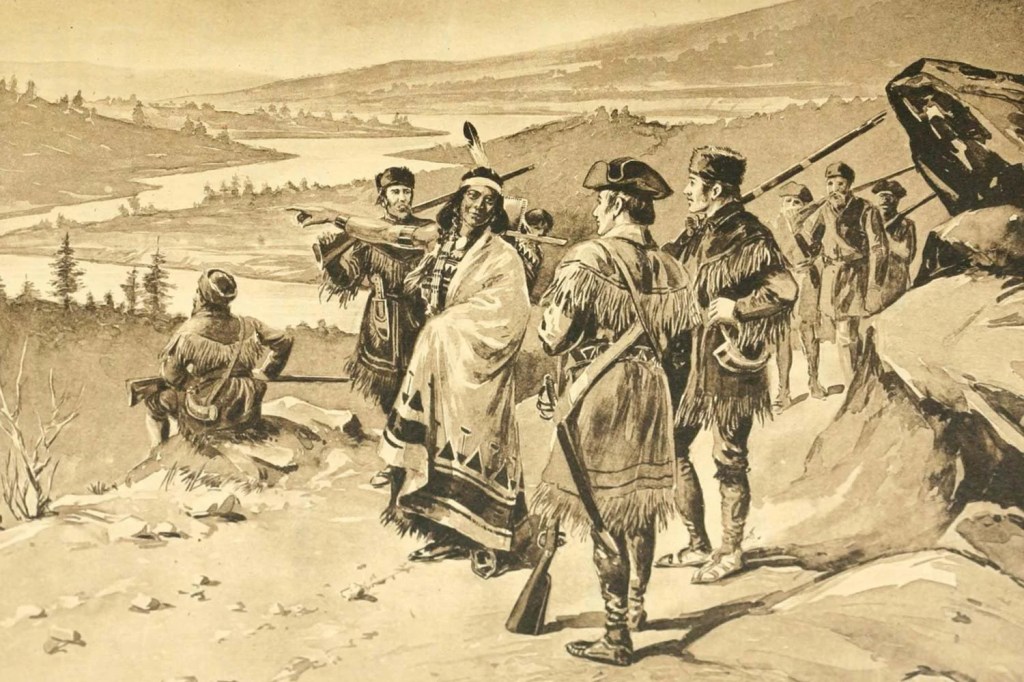
~Painting of lewis and clarke. That’s the idea. Silly Europeans (basically) brute forcing their way through the unknown~
Now we could spend some time talking about the way the guild operates, and the players’ role as hired muscle to clear dungeons, the navigation crews, the rotation schedule they use to avoid cave madness, the loot registration system, and how the linguists and archaeologists employ personal escorts to keep themselves safe… but that’s all a topic for another day. What’s far more interesting at the moment is the information available to players, and how I want to go about inspiring a sense of mystery and awe in them.
The Frontier is death, or rather a part of the world pulled towards death, as discussed above, and we’ve got a pretty fleshed out set of explanations and explorations around that deep background lore. These and other deep truths of the world however, are things that no one in the game should know, and that no player should ever be told explicitly. If they are able to guess at the truth of these secrets based on thematic elements and flavor and the events of the game… then actually I’d say we’ve succeeded in our design goals but it should never ever be directly revealed.
This little idea is becoming one of my founding design principles. The creator of a lovely little game called Troika! has a great quote about mystery and wonder in games. I’m too lazy to go and find its exact wording but it says something like this. “Settings with deep and fantastical lore that inspire awe at first often ruin it with encyclopedic textbooks that explain away all the mystery. Let. There. Be. Unknowns.” So Troika! does just that, it gives you really evocative imagery to play with and tons of super compelling story hooks and tastes of backstories that whisper and promise a grand epic adventure… but then it doesn’t prescribe the answer to those things. There is no set reason why the king of Amon Ra has been crying for the last 119 years straight. The game simply does not provide an explanation whatsoever. The lore is up to the players to make up and discover on their own. Now that’s exciting!
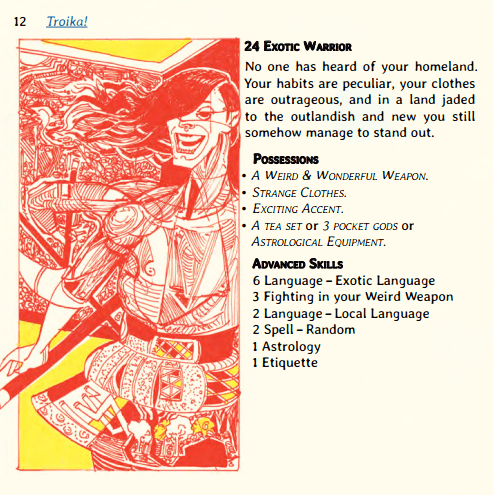
~Example of a Troika! Character. This is basically all the game gives you. What is a “Pocket God”? I have no idea, but doesn’t that make you want to get up immediately and go write something awesome about it? ~
This is a really cool philosophy, and if you want a more in depth explanation then this guy here does a great job. But I have something else in mind. Let’s steal this lovely idea and tweak it a little for my own purposes. Instead of just leaving the lore of the world completely open ended, let’s come up with those juicy explanations ourselves as the designers, and let that make the setting consistent. Ah yes, the king of Amon Ra hasn’t actually been crying for 119 years, he’s stuck in a time loop caused by blablabla, oh and look that also explains why Drouj the city eater, wyrm scourge of muck and mire appears to be immortal and returns every 3 years to level civilization despite being slain every time. He’s also stuck in a time loop for the same blablabla. Lets never ever tell the players about blablabla though, let them come up with their own theories and see if they work (and as a GM maybe we’ll decide their story is better, and to swap it in for parts of our own). The world really is consistent, you just don’t have all the information.
This makes for a lot more work on the design side, yes, but luckily I have no life and this is fun for me. The benefit is going to be noticeable too. The world is going to feel coherent, even if the players can’t quite tell why. It means we get to keep the wonderful mystery without worry about our game flying off into exponentially increasing entropy. A king who’s been crying for 119 years straight and a great worm that keeps reincarnating to destroy us all. Something about that rhymes, even without knowing the backstory. As an audience, we don’t have to know, and in fact not knowing keeps that precious mystery alive. For the writer though, having that bedrock explanation makes it easier to tie different things together. It’s the difference between Jackson pollock splattering paint all over a canvas and a 1st grader smearing his paint covered hands all over a sheet of computer paper. They’re both a glorious mix of colors, but one of them was done by someone who knows about color theory, and can stretch a twenty foot canvas. In one of them there’s a method to the madness. This is my theory at least. I’m gonna stick to it for now and see how it pans out.
By the way, don’t show this to my dnd group, it’ll ruin the game for them.
 Paragon
Leave a comment